
Research & Development
Our Processes
- Selective Laser Sintering (SLS)
- Powder Bed Fusion (MJF/SAF/HSS)
- Stereolithography (SLA)
- PolyJet (PJM) -EN
- CAD, manufacturing-oriented building component design & reverse engineering
- Measurement technology
- Metal casting
- Selective laser melting (SLM)
- RapidTooling (RT)
- CNC Machining
- Model making (MB)
- Vacuum casting (VAC)
- Fused Deposition Molding (FDM/FFF)
Innovation has always played an important role at cirp, whether in materials, additive processes, or process chains. This is because we have been passionately committed to additive manufacturing almost from the very beginning. The diversity and dynamism of this manufacturing family has greatly increased its importance for the economy, politics, and consumers, especially in recent years.
Digitalization, especially the commercially used “Internet of Things” summarized under “Industry 4.0,” is becoming increasingly important for the production of prototypes and small series. cirp not only accompanies these developments, but also actively shapes them. We achieve this in close cooperation with our customers, suppliers, and a network of institutes and international research facilities that has grown considerably over the years. Joint projects are an important component of these research activities. Here, institutes work together with small and medium-sized enterprises or selected large companies to advance specific innovation topics in a way that no single partner could achieve alone. This research into selected, promising projects and consortia is publicly funded.
cirp is exceptionally involved in regional initiatives and tenders from federal ministries and the EU because we are convinced that only innovation can guarantee the satisfaction of our customers. The great dynamism in our industry is rapidly changing the demands on our employees and their qualifications. With an active commitment to innovation, their knowledge and skills are constantly evolving.
If we are unable to fulfill a request today, please ask us about it anyway. It is quite possible that the solution is already in the works or that we can achieve our goal together with selected network partners.
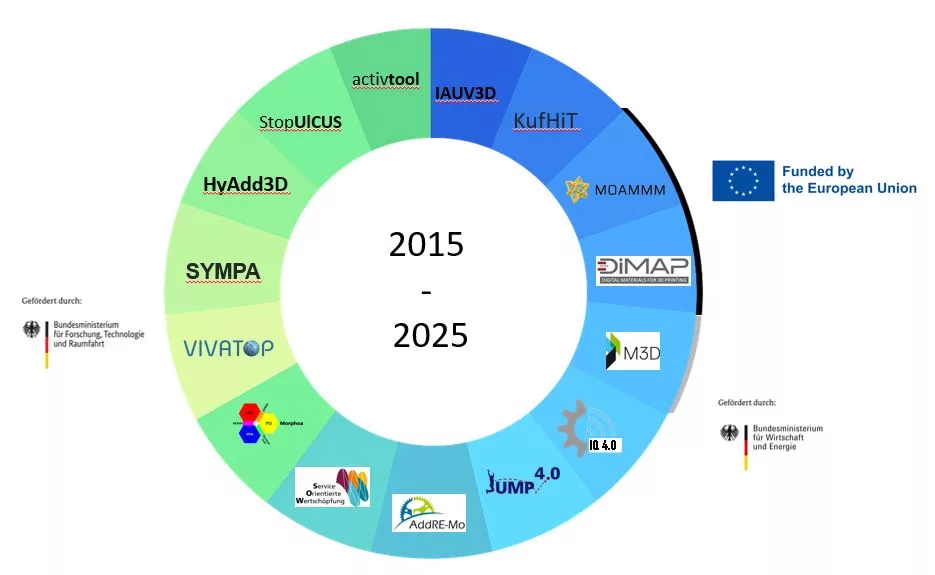
The activTool project develops intelligent, activity-supporting tools that enable older production workers to perform precise manual assembly tasks despite age-related limitations. To this end, a networked, sensor-based workstation is being implemented that automatically coordinates tool movements, workpiece pick-up and arm support, thus supporting fine motor skills. The solution contributes to higher work quality and enables experienced skilled workers to continue to contribute their expertise to precision processes.
The project is developing novel UV-curing polymers based on biogenic itaconic acid to overcome the disadvantages of conventional acrylate-based resins, such as shrinkage, brittleness and low heat resistance. The new materials are suitable for SLA, DLP and MJM processes and enable significantly more efficient components, for example with higher heat resistance and lower embrittlement. Initial material samples show high application potential – from automotive functional components to individually manufactured series – while also increasing sustainability through the use of renewable raw materials.
The project aims to open up additive manufacturing for demanding functional components by expanding the range of materials to include high-performance thermoplastics. To this end, glass and carbon fibre-reinforced material systems based on PPS, PEEK and their blends are being developed to meet high thermal, mechanical and tribological requirements. The newly developed materials are qualified for industrial 3D printing through systematic formulation development, process optimisation and extensive validation on test specimens and demonstrators.
The project is developing a data-driven methodology for the additive manufacturing of mechanical components with optimised lattice or metamaterial structures, thereby enabling targeted modification of material properties without changing the base material. By coupling process, microstructure and component properties with modern simulation, uncertainty assessment and two-scale optimisation, lightweight, soft or highly functional lattices can be reliably predicted and designed. On this basis, the project – together with partners such as cirp – is opening up new ways to realistically simulate and optimise lattice structures and make them usable for high-performance energy-absorbing applications.
The DIMAP project is developing innovative, nanotechnology-optimised inks for PolyJet multi-material printing technology in order to significantly expand the material diversity and functionality of additively manufactured components. This will advance PolyJet 3D printing from pure prototyping to the production of functional applications, such as soft robotics components and customised lighting. Accompanied by safety, risk and life cycle assessments, new high-performance material classes and an advanced multi-material 3D printer are being developed, strengthening Europe’s competitiveness in the field of additive manufacturing.
Spare parts and 3D design data are often unavailable for older rail vehicles or cars. Together with Fraunhofer Institutes, Siemens and other partners, cirp has investigated how defective components can be digitally reconstructed through scanning and reverse engineering and then additively manufactured. Today, customers benefit from an established process chain: cirp uses two GOM scanners and Geomagic software to generate precise, processable CAD data.
Industry 4.0 generates large amounts of data that conventional quality management systems are hardly able to utilise, even though they offer great potential for early detection of faults and wear. The IQ40 research project is developing a concept for intelligently collecting and filtering quality-relevant sensor data and making it available both internally and externally. An adaptive set of rules enables companies to detect malfunctions early on, respond more quickly and thus improve quality while significantly reducing downtime, waste and costs.
The JUMP 4.0 research project developed the JUMP Planner, an interactive process management system that shifts the rapid evaluation and scheduling of customer enquiries directly to the production area. By intelligently linking management decisions, empirical knowledge and ongoing manufacturing processes, the system helps foremen to respond more flexibly and make more informed decisions. This significantly improves planning, throughput times, productivity and delivery reliability, and creates a holistic approach to Industry 4.0 measures.
The AddRE-Mo project is developing value retention networks for urban electric mobility in order to return e-bikes at the end of their life cycle to closed product cycles through remanufacturing and additive manufacturing. The aim is to create sustainable solutions that make components repairable, conserve resources and extend the service life of e-bikes. Funded as part of the BMBF’s ‘ReziProK’ initiative, the project is helping to establish innovative concepts for a resource-efficient circular economy.
SOW develops a generic value creation model and methods to make service-oriented offerings comprehensible and enable early evaluation. A formal mathematical metamodel describes the operating principles and dependencies of new service and business model constellations. The results, which are available as open source, support stakeholders in planning networked service bundles economically and implementing them fairly in multi-stakeholder partnerships.
The Morphoa project supports start-ups and SMEs in quickly integrating photonic technologies into their products using a modular methodology and suitable hardware and software tools. To this end, application-oriented, easily adaptable optical modules are being developed that can be used with minimal prior knowledge and can be configured using an expert system. This enables companies to create tailor-made demonstrators in a short time and flexibly implement a wide range of photonic functions, such as 3D capture.
New technologies such as virtual reality, augmented reality and 3D printing are opening up completely new possibilities in medicine, for example when students perform virtual dissections, patients view their organs in 3D, or experts around the world are connected live to operating theatres. The VIVATOP research project uses these technologies to make surgical procedures and training in visceral surgery more efficient and safer by providing precise information for planning and surgery. In addition, VR, AR and 3D-printed organ models create completely new training and education scenarios that enable realistic practice situations and improve the quality of medical teaching in the long term.
As part of the BMBF programme ‘From Material to Innovation’, the SYMPA project is developing new durable materials, optimised processes and health-friendly post-treatment methods for stereolithography in order to significantly expand its industrial use, particularly in the automotive industry. A German-Austrian consortium of industry and research is working on UV-stable, mechanically efficient SLA materials, more efficient polymerisation processes, fibre-reinforced structures and improved surface and plasma treatments. Using typical automotive components as examples, the technologies are being tested holistically to demonstrate reduced process times, higher component quality and the long-term industrial usability of SLA.